The short-term and long-term success of your business depends on making the correct decision about which industrial reverse osmosis (RO) plant is most appropriate for your unique application. The wrong choice of RO system can cost your business much more than just money; purchasing an inferior RO unit could result in lost production time, damaged equipment, and regulatory headaches. When determining your industrial water treatment requirements, it is essential to connect these requirements with an appropriate RO system prior to signing any contracts.
In this guide, you will learn how to evaluate your unique industrial water treatment needs, calculating the appropriate capacity for your operation and identifying critical components and features that are necessary for a quality RO system, and budgeting for the total cost of ownership. Additionally, we will provide you with guidance on selecting reputable suppliers, as well as who will provide you with high-quality technical support at the time of your greatest need.
Assess Your Business Water Treatment Requirements
Analyze Daily Water Consumption & Peak Demand Times :
To choose the proper industrial reverse osmosis (RO) plant, you will need to know your water consumption patterns. Your first step is to measure your daily water use for several weeks to create a base line of what is required. Your business probably has some variation in water use through the day, with those higher peaks usually during shift changes or specific production cycles.
You’ll want to measure your water flow during the busiest operational time of the day to get an idea of the highest rate of flow. For example, a factory may consume 500 gallons of water on a daily basis but, at its peak production, require 150 gallons per hour. The highest demand will determine the capacity specifications for the RO water system in the company.
You should also consider the seasonal pattern of water consumption. Most food processing plants will see an increase in their demand for water during harvest time, while the cooling tower application will have a maximum demand during the summer months. Keep track of these patterns so you don’t undersize your commercial water treatment system.
Identify Water Source Specific Contaminant
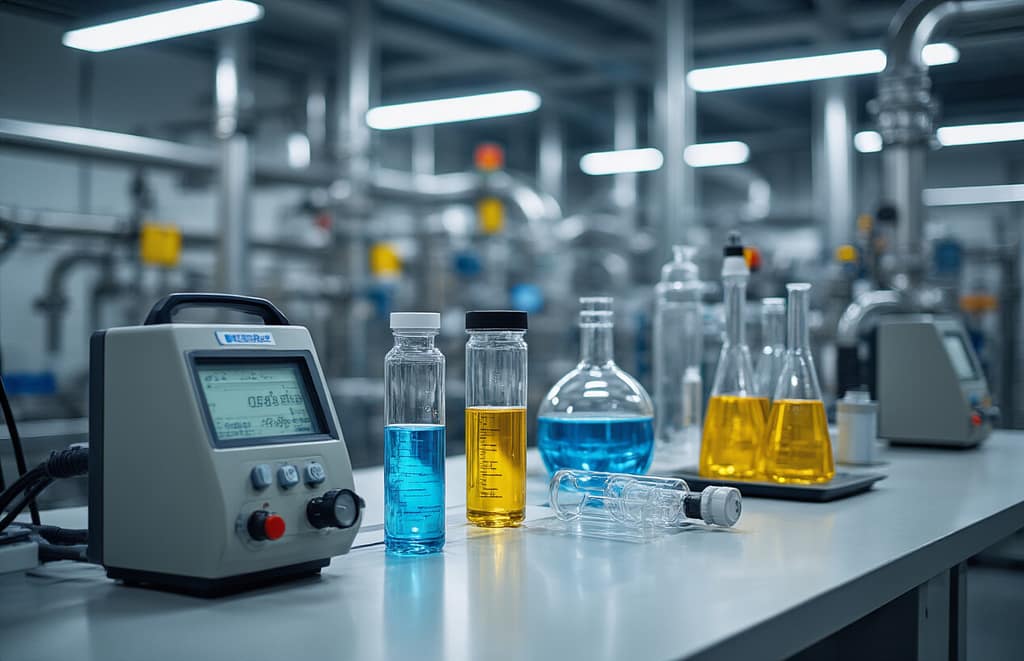
Identifying the specific contaminants that you must remove from your water source (treatment) will provide a basis for the development or acquisition of an industrial water purification system (your water system). The contaminants typically found in municipal-supplied water include chlorination agents and dissolved minerals, as well as all of the trace chemical compounds commonly found in drugs. Well water will often have high levels of iron, manganese, and other hard-water minerals.
The following types of testing should be performed:
- Test for Physical Parameters: Color, turbidity, and odor
- Test for Chemical Analysis: pH, total dissolved solid (TDS), chloride, and sulphate ions.
- Testing for Biological Contaminants: Testing for bacteria, viruses, and organic contaminants.
- Testing for Heavy Metal Contaminants: Testing for lead, mercury, arsenic, and chromium.
Various Industries will face different sorts of contaminants. Electronics manufacturers have chemicals that are ionic and will damage sensitive components, while Pharmaceutical manufacturers have endotoxins and/or pyrogens in their ingredients. Agriculture producers have to deal with pesticides and nitrates (from fertilizer runoff).
The profile of contaminants will guide your company on what pre-treatment components your system will need to remove from water prior to being sent to reverse osmosis membranes.
To identify the water quality standards that correspond to your sector, you can consult with your regulatory body.
Water quality standards are dependent on both Industrial Regulatory Agency(ies) and manufacturer’s specifications for the product(s) you will be making. Performance of your Reverse Osmosis (RO) system(s) will be directly related to these requirements and, therefore, must be met continually for the existence and of the system’s efficiency and operation.
|
industry |
Key Standards |
Typical Requirements |
|---|---|---|
|
Pharmaceuticals |
USP, FDA |
<1 ppm TDS, <10 CFU/ml bacteria |
|
Electronics |
ASTM, SEMI |
<1 µS/cm conductivity, <50 ppb silica |
|
Food & Beverage |
FDA, HACCP |
Chlorine-free, specific pH range |
|
Power Generation |
ASME, EPRI |
<0.2 ppm silica, low conductivity |
When you are assessing your quality control needs, take a close look at the specifications of the type of application you will be supplying water to. Some applications will require the water to be “clean” only, while other applications will have ultra-pure standards that will require an extra step of polishing after the water has been treated through reverse osmosis. Conductivity levels for boiler feed water applications must be below 5 µS/cm; conductivity levels for some semiconductor manufacturing applications need to be above 15 MΩ-cm.
Also, document any unique requirements for example: temperature ranges, the manner in which to store the water, or how the water will be distributed.
Evaluate Future Growth Plans and Scalability Requirements
Intelligent capacity planning incorporates both anticipated business growth and evolving operational needs. Many businesses implement systems that meet their immediate requirements but very little wiggle room for upgrades — often resulting in significant upgrades or complete new installations just a few years after the original installation.
Develop a projection for the future growth of your business’s water use over the next five to ten years based on the following factors:
- Increasing production capabilities due to the addition of new product lines and increased manufacturing volume.
- Facility expansion plans include the development of new facilities or the addition of new facilities to your current location.
- Upgrading technology means sourcing equipment capable of producing quality water that meets regulatory standards.
- Implementation of new regulations has resulted in increased compliance costs associated with the need to meet more stringent effluent discharge limitations imposed by regulators.
Modular system components allow for flexibility as businesses grow over time and need to increase their water processing capacity. Business water filtration systems should be designed so that as business growth occurs, large capital expenditures are not necessarily required to increase capacity; likewise, modular systems should be able to accommodate high volumes of water processing as production levels increase.
In addition to capacity growth issues, businesses must also consider spatial constraints imposed by future growth needs. Installing a new system or reconfiguring your existing system will minimize the expense of relocating your system. Some manufacturers have developed skid-mounted systems which are manufactured in a manner that allows you to easily parallel multiple skid-mounted assemblies, or quickly upgrade skid-mounted assemblies compared to large custom-built installations.

Understanding Industrial RO Plant Capacity and Performance Specifications
Identify Your Current and Projected Water Demand and Design Your Industrial RO Plant Accordingly.
Determining the appropriate size of your industrial reverse osmosis (RO) system starts with clearly identifying your daily water usage for the business. Look at all areas in which water is being used throughout your operations, including manufacturing processes, cleaning processes, and general facility requirements. The majority of businesses will size their systems based on only their current (today’s) water demand. To effectively plan for future growth, you also need to consider your anticipated water usage needs for the next five to 10 years.
When planning for future growth in water demand, consider your future business growth. Will you be adding new production lines to your operations? Will you be acquiring additional equipment to meet growing customer demand? Will you be increasing the number of employees in your facility? All of these factors will increase your water demand; therefore, it is recommended that you design your reverse osmosis system to accommodate 20% to 30% more than your current peak water use to allow for future growth and/or an unexpected surge in demand.
Your business’s peak water usage is equally as important as the average use of water in your facility. Just like you would document your average water usage by season or production cycle, you should also log your peak water usage at various times during your production process.
In addition to sizing your reverse osmosis system based on your facility’s peak usage, you should also keep in mind that you will have to plan for some form of water source or backup storage capacity if you should experience maintenance downtime with your reverse osmosis system.
Managing recoverable rates and reject water
The recoverable rate of your company’s industrial water purification system is used to quantify how effective it is in turning raw (unprocessed) water into healthy, drinkable water. In general, most commercial reverse osmosis (R.O.) systems will recover between seventy and eighty-five percent of the water introduced to them, meaning seventy to eighty-five percent of what is added to the system has been treated to become purified water, while the other fifteen to thirty percent becomes reject water; i.e., concentrated contaminants from the raw input water.
Although high recoverable rates may sound good on paper, you should consider what could happen by pushing the recoverable rate beyond what has been established as a normal or recommended level. When a company’s industrial water purification systems exceed the recommended recoverable rate, membrane damage can occur and membrane life will be shortened. The maximum recoverable rate for the system will be determined by your feed water quality; therefore, if the feed water quality is high, then a company could expect to achieve high recoverable rates. In contrast, companies that have highly contaminated feed water will need to set their systems at more conservative levels relative to recoverable rates.
Management of reject water must be included in your planning process; in many areas, due to local environmental standards, reject water cannot simply be released down the drain. There are several options for management of reject water, including:
- Systems that recycle reject water for non-critical use
- Zero liquid discharge systems, where no waste water is produced
- Removal of reject water through permitting/licensing with waste management services
- Mixing reject water with other wastes for disposal/travel, if permitted by local regulations
Once you have calculated the amount of reject water produced each day, factor the disposal/treatment costs for that reject water into your operating budget. In addition to the above-listed options, some companies are able to formulate creative solutions for utilizing some of their reject water in other processes, such as using as irrigation for yards/orchards or as a source of cooling for towers and/or cleaning equipment after processing.
Conclusion
Choosing an appropriate industrial reverse osmosis (RO) plant requires a clear understanding of what type of water is needed for your application (e.g., industrial vs. drinking), how much capacity you will require, and what types of contaminants are present in the incoming water supply.
In addition to selecting the best features and most efficient technologies for long-term success, it is important to develop your budget beyond just the purchase price. Factors such as installation costs, maintenance costs, energy expenses, and ongoing support should all be considered when determining the best option for you.

Having a dependable supplier and properly sizing the system are essential for providing consistent, high-quality water to your customers for an extended period of time.
Hi, this is a comment.
To get started with moderating, editing, and deleting comments, please visit the Comments screen in the dashboard.
Commenter avatars come from Gravatar.